

Welcome, Anticitizen. What does Peter Thiel’s recent $12 million purchase in Argentina have to do with you? You’ll learn in today’s letter.
Please note → Yes, I know I’ve been off writing for a year. Thank you all for your patience.
👓 ESTIMATED READ TIME: 5 min 40 seconds

An impending end.
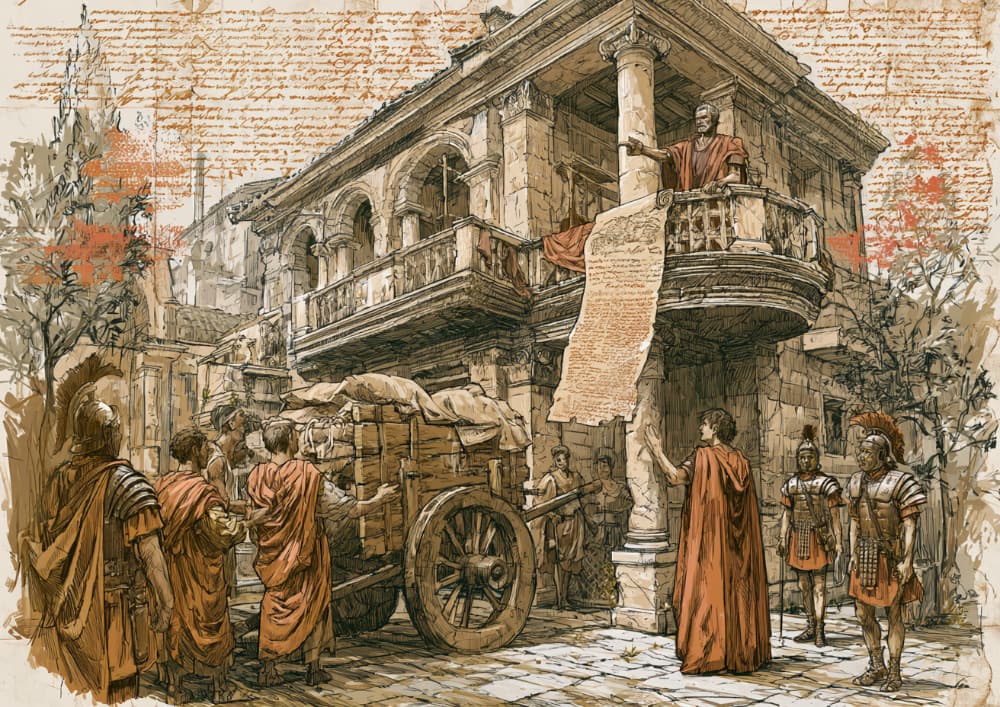
In the year 398 AD, a man named Quintus Aurelius Symmachus, the former consul of Rome and one of the most powerful senators in the empire, stood in the atrium of his city home, giving quiet instructions to a flurry of men who laboured to load dozens of sturdy wooden wagons.
These weren’t the frantic movements of a man fleeing in fear. They were instead the measured, deliberate actions of someone who thoughtfully decided these actions some time ago.
Crates of silver. Chests of coin. The kind of wealth that, when moved carefully and spread across enough locations, would ensure that no single catastrophe could ever reach all of it at once. And very soon, these heavily-laden wagons would roll south, directed towards his estates in Campania. Others had already escaped to Sicily. And more still to Mauretania, on the north-western coast of Africa.

Symmachus spent decades at the very centre of Roman power. As one of the senators who shaped the empire's decisions, he had sat in the empire’s halls of power for half a lifetime. He had read the dispatches from the northern frontiers, where Germanic tribes had attempted to press in for years. He’d also watched the treasury strain, the legions become stretched thin, and the empire’s promises of stability grow louder in direct proportion to how little they were believed by the people.
Most of all, he understands what’s coming next. Not the exact details. Not the date. Yet still, he knows.
And he’s not alone. Across Rome, others with the access to similar knowledge have come to similar conclusions. Melania the Younger, one of the wealthiest women in the known world, had left Rome that very same year. She departed first to Sicily, then to North Africa, where her holdings were vast enough to sustain an entirely independent existence far beyond the reach of whatever was about to occur in Rome.
The likes of Symmachus and Melania the Younger didn't simply buy land and leave. The most powerful among them had taken to maintaining what the Romans called bucellarii: private armies, paid for by their own purse, loyal not to the emperor, but to those who fed and equipped them. Recruited from Romans, Goths, and Huns alike, these soldiers were often better armed and better trained than the imperial legions themselves. The state no longer had a monopoly on violence.
The preparations of Rome’s elite were thorough and complete. And they didn’t come a moment too soon.
On the night of August 24th, 410 AD, Alaric's Visigoths poured through the Salarian Gate and tore Rome apart for three days. Yet the wealthy didn’t suffer, for the wealthy were no longer there. It was the merchants, the craftsmen, and the ordinary citizens of Rome who had nowhere to go that bore witness to the end of their civilisation as they knew it.
And for many, the end of their lives.
Thus began what history calls the fall of Rome.
But for those wealthy few who had spent years converting their power into land, spreading their holdings across continents, and building private armies loyal only to them, Rome's darkest nights were little more than a distant rumble from the terrace of a well-stocked Sicilian villa.
Our own downfall.
A few weeks ago, tech billionaire Peter Thiel purchased a $12 million USD home in the Barrio Parque neighbourhood of Buenos Aires. A house that’s less than 200 metres away from where I sit at as I write these words.
It’s a beautiful house. I walked past it this morning.

Photo: Google Street View
And it’s already crawling with private security.
In recent years, Thiel has also purchased millions in property in New Zealand at the far end of the world. This includes land that, allegedly, he intends on using to place to build a vast underground compound.
Despite these expensive purchases, Thiel likely has no desire to live in either Argentina or New Zealand.
That is, unless civilisation as we know it ends.
For the past few years, the world’s global elite have spent untold trillions on preparing for the impending possibility of an “event.” Not a specific event in particular, though an event that could range from a civil war, to an economic collapse, or even to all-out global nuclear warfare.
And it isn’t just property they’re amassing. Some, like Meta’s Zuck are building bunker homes in Hawaii, others like director James Cameron are purchasing farms to ensure a steady food supply, and many like OpenAI’s Altman are directly preparing for war by stocking up on guns, potassium iodide and IDF-spec gas masks.
And to mirror the Roman senators of old, many seem to also be building their own private armies.
(Story continues below…)
It’s time to build a backup plan. Today.
Can you see the signs? Anticitizen members are getting second (or third) passports, moving their money offshore in days, and cutting their tax bill to zero (legally). While everyone else watches their options disappear, they're building a global insurance policy against their home country. Get started today at no cost with a 7-day trial to Anticitizen.

Elon Musk, the world's richest man, owns his own private security firm called Foundation Security. Staffed with former U.S. Army Special Forces personnel, operating with its own code names and protocols, and loyal to one man alone. And early last year, members of his personal detail were formally deputised by the U.S. Marshals Service, granting them federal law enforcement powers.
A private citizen's personal army, now operating with the authority of the state.
It's the bucellarii of the 5th century, rebuilt for the 21st.
Now when you look at all of this together—the properties, the bunkers, the farms, the private armies, the gas masks and the guns—a very obvious question emerges:
“What do these people know that we don’t?”
These are not irrational men acting on fear.
They’re not paranoid. They’re prepared.
Thiel co-founded PayPal and was the first outside investor in Facebook. Altman runs the most consequential AI company on the planet. Musk runs the world's most valuable car company, its dominant space programme, and the world's most-used satellite internet network. These are not men given to panic.
They are, however, men who have spent their careers identifying patterns others miss, acting on information others don't have, and positioning themselves accordingly. And doing so long before anyone else has any reason to worry.
Sound familiar?
The senators of Rome didn't flee in panic either. They read dispatches, they were the first to be handed the rolled missives delivered by messengers, and they listened intently to the whispers of spymasters. And when they understood which direction things were heading, they moved. And they did so quietly and deliberately… and they did this years ahead of everyone else.
Now, I'm not suggesting you spend $12 million on a mansion in Buenos Aires, or start carving an underground compound into a New Zealand hillside with a spoon.
But if you strip away the drama of the headlines, what the elite are actually doing is very simple: they’re spreading their risk, they’re diversifying themselves geographically, and they’re ensuring that no single government, economy, or catastrophe can reach everything they own at once.
That’s the game. That’s the entire game.
And unlike hiring former Navy SEALs to protect you, being a player in that simple game is available to almost anyone.
A second passport or residency permit means that if your government freezes your assets, collapses its currency, or simply decides you're no longer welcome, you have somewhere else to go, and the legal right to be there. Paraguay offers one of the most accessible residency pathways in the world; no investment required, with a total cost around $1,000 (if done yourself). Argentina, where I'm writing this now, has government fees of barely $15, though you'll need to show a modest passive income.
An offshore bank account outside your home government's reach means your money isn't all in one place. And I believe this is an essential “must have” considering our governments are increasingly comfortable freezing accounts of people they disagree with. Dominican Republic, Cambodia, and the Philippines are among the non-CRS jurisdictions worth considering.
And lastly, owning some physical gold or silver outside the banking system means you can store and exchange value regardless of what happens to the digital financial infrastructure around you.
None of this requires a billionaire's budget. It simply requires a decision.
Just like today, the real advantage Symmachus had over the ordinary citizens of Rome wasn't his wealth. It was his access to information, and his willingness to act on what it was telling him before it became obvious to the peasantry.
The dispatches from the northern frontiers still exist. They just look like de-banking stories from the UK and Canada, spiralling government debt due to our leaders’ inability to balance budgets, and tech billionaires buying property at the ends of the earth.
The question is whether you treat that information the way Symmachus did. Or whether you’ll suffer the same fate of the ordinary citizens of Rome.
The citizenry who had every reason to believe the empire would hold. Right up until the moment that it didn't.
Start planning before you need to. Not after.
Or to put it another way…
The wagons are leaving. Make sure you're on one.
Written by Leon Hill.
Founder, Anticitizen.
P.S. — Start building your own backup plan like Thiel (with no $12 million investment needed) and start a trial with Anticitizen today. No risk. No fluff. Just actionable intel, guidance, and support.

This newsletter is for educational purposes, and is not financial advice. Please do your own research, and consider risks involved with investing or purchasing any asset.